Accave
"Learn at your pace. Revise with confidence."
Secondary students lacked flexible revision tools, tied to classroom timetables and teacher availability for the moments they actually needed to revise.
How to read this case study: what I owned, what shipped and the verified outcome (My Role, What Shipped and Impact below) are factual. The surrounding strategy, vision, alternatives and metrics framework are interview-ready framing built on those facts, how I'd talk through the product thinking, not a claim that every metric or GTM motion was formally run at the time.
Challenges & baseline.
Challenges
Traditional secondary learning is timetable-bound, teacher-dependent and classroom-dependent, students need revision when the teacher isn't available, and the existing options didn't give them a way to understand, revise and test themselves on their own schedule. Digital education continues to matter for widening access to learning, and frameworks like UNICEF's education strategy explicitly focus on measurable learning outcomes rather than access to technology alone.
Baseline
Self-paced revision access before this app: dependent on classroom timetables and teacher availability.
What the customer actually needed.
Insight
Students don't necessarily need another "school online", they need a way to understand a lesson, revise it, test themselves, and repeat, on their own schedule rather than the classroom's. That reframes the product away from replicating a classroom and toward a self-paced revision loop built around curriculum-relevant content.
Job to be done
When I need to revise a lesson and the teacher isn't available, let me understand it, practise it and test myself on my own time.
Vision, mission & the bets we made.
Every student able to understand and revise a lesson whenever they need it.
Make secondary-school learning simple, accessible and self-paced.
Give students a way to revise outside class hours without needing a teacher present; keep content curriculum-relevant rather than generic; make self-testing (quizzes) part of the core loop, not an afterthought.
Ship explainer-video lessons with accompanying notes; ship quizzes and exam-preparation content; publish to Google Play.
Strategic bets
- Build a self-paced revision loop, understand, revise, test, repeat, rather than replicating a classroom online
- Keep content curriculum-relevant so revision maps directly to what students are actually being examined on
- Ship quizzes as a core part of the loop, not an add-on, so self-testing is built in from the start
Alternatives considered
The product could have positioned itself as a full online-school replacement, live classes, full curriculum delivery, a much larger and slower build. The direction taken was narrower and faster: self-paced, curriculum-relevant revision built around explainer videos, notes and quizzes, addressing the specific gap of "I need to revise this now and no teacher is around" rather than replacing the classroom entirely.
What I owned.
Product lead on Accave's learning experience.
What shipped.
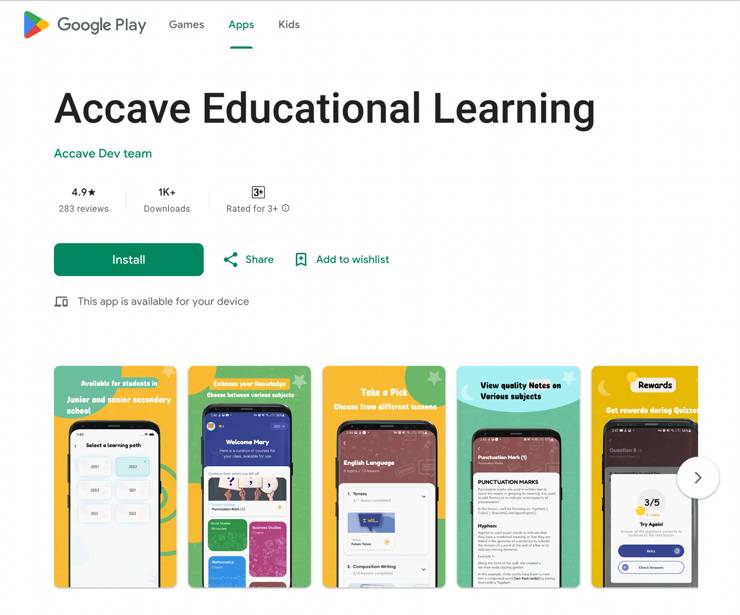
A self-paced, explainer-video learning app with lesson notes, live on Google Play.
How it got built.
Scoped the core revision loop around explainer videos, lesson notes and quizzes
Built and published the app to Google Play
Structured content around curriculum relevance for secondary students
How this reaches customers.
Three plausible acquisition engines for a product like this: direct to parents and students, distribution through schools, and exam-driven acquisition around WAEC/NECO/JAMB-style preparation periods where curriculum-relevant revision content creates a high-intent moment. The verified fact is that the product reached Google Play; the broader GTM motion beyond that isn't something I can substantiate here.
North star metric.
Supporting metrics
- Recommended North Star going forward: weekly active learning students, not lesson-count alone
- Lessons completed per student and quiz-score improvement
- Return learning days and D30 retention
Guardrails
- Content curriculum-alignment accuracy
- Quiz completion rate versus abandonment
The verified bottom line.
Learning back in students' hands, live on Google Play.
What I'd do differently.
A narrower, faster scope, self-paced revision rather than a full online-school build, got real content into students' hands sooner. The interview-ready lesson here is choosing depth on one loop (understand, revise, test) over breadth across a whole curriculum delivery platform.
More proof, more products.
See every product shipped and business built.