Checkout conversion
"Intent in. Order out."
A leaking e-commerce checkout funnel across the US and Canada, customers who had already decided to buy were still failing to complete the purchase.
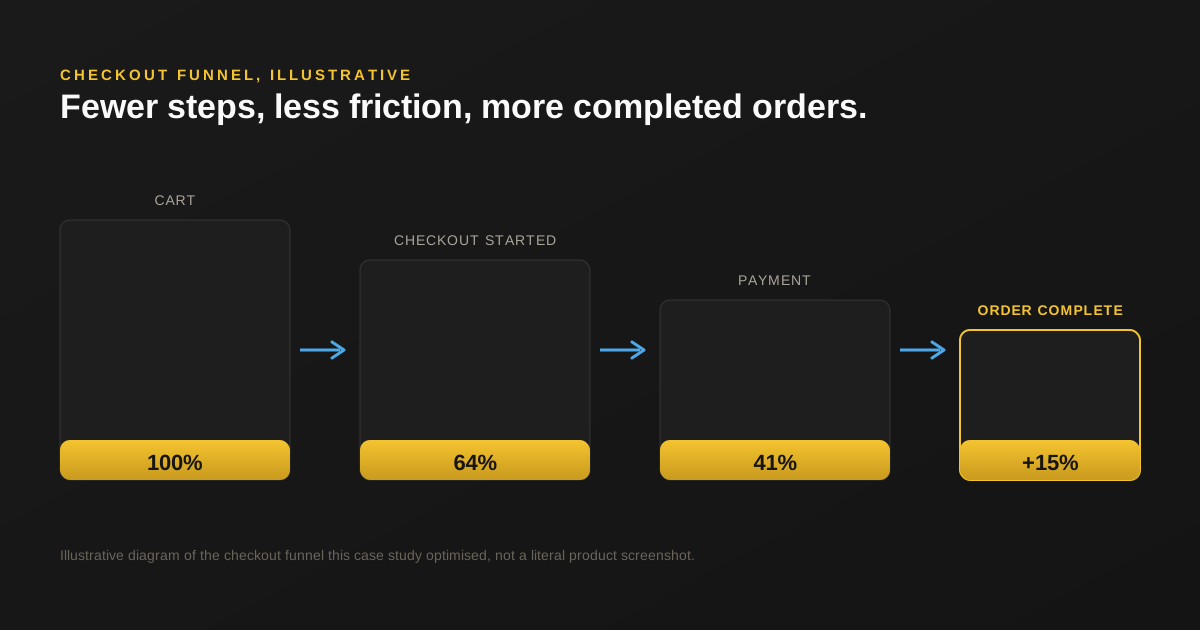
How to read this case study: what I owned, what shipped and the verified outcome (My Role, What Shipped and Impact below) are factual. The surrounding strategy, vision, alternatives and metrics framework are interview-ready framing built on those facts, how I'd talk through the product thinking, not a claim that every metric or GTM motion was formally run at the time.
Challenges & baseline.
Challenges
By the time a customer reaches checkout, they've already decided to buy, the funnel problem is fundamentally different from discovery: the product is losing already-motivated customers between intent and transaction completion. Checkout complexity is a well-documented abandonment driver industry-wide, Baymard's ongoing research continues to find checkout friction is a material reason shoppers abandon an order.
Baseline
Baseline checkout conversion prior to the initiative (specific baseline figure not published here; the verified, measured result is the +15% lift).
What the customer actually needed.
Insight
At checkout, adding capability can reduce value, unlike earlier in the funnel where more information helps a customer decide, at checkout every additional decision, field or surprise is a chance to lose someone who had already committed to buying. The objective flips from persuasion to removal, remove cognitive load, unnecessary fields, errors, uncertainty and payment friction.
Job to be done
When I've decided to buy, let me complete the purchase with minimal effort, clear pricing, clear progress and confidence that it will work, so I don't have to second-guess the transaction.
Vision, mission & the bets we made.
No customer who wants to buy should be prevented from completing the purchase by the checkout experience itself.
Systematically remove friction between purchase intent and completed payment.
Diagnose exactly where in the checkout funnel motivated customers were dropping off; reduce cognitive, operational and payment friction without adding new capability that could itself become friction; keep every change tied to a measurable hypothesis rather than a redesign preference.
Establish a reliable funnel baseline; identify and prioritise the highest-friction steps; run controlled experiments against them; roll out winning variants while protecting guardrail metrics.
Strategic bets
- Treat checkout as a measurable behavioural funnel, not a design refresh, every change tied to a hypothesis and a conversion outcome
- Prioritise interventions by impact × confidence ÷ effort rather than by internal opinion about what "looks better"
- Protect guardrail metrics (AOV, fraud, refunds, support contacts) alongside the headline conversion number, so the win couldn't quietly cost the business elsewhere
Alternatives considered
The team could have treated this as a redesign project, a fresh checkout UI shipped as a single release. Instead we treated checkout as a measurable behavioural funnel: establish baseline, identify the highest-friction steps, generate hypotheses, prioritise by impact/confidence/effort, test with a controlled population, monitor conversion and guardrails, then roll out winning variants progressively. That discipline, hypotheses in, conversion out, rather than shipping a redesign and hoping, is what the case is built to demonstrate.
What I owned.
Product lead on checkout optimisation, led a team of 15+ across funnel analytics, UX research, payments, engineering and commercial stakeholders, owned problem definition, prioritisation and rollout decisions.
What shipped.
Led a 15+ person team on checkout optimisation, running funnel diagnosis, hypothesis prioritisation, controlled experimentation and progressive rollout against the checkout funnel end to end.
How it got built.
Established a funnel baseline across product view, add to cart, checkout start, customer details, delivery, payment and order completion
Diagnosed where leakage concentrated using funnel analytics and step-level drop-off
Generated specific hypotheses (e.g. reducing unnecessary fields, surfacing pricing and delivery information earlier, clarifying error recovery) tied to an expected conversion mechanism
Prioritised hypotheses by impact, confidence and effort, then tested against a controlled population
Monitored conversion and guardrail metrics together before rolling winning variants out progressively
How this reaches customers.
This wasn't a traditional external go-to-market, the audience was already-committed customers mid-funnel. The rollout motion was internal: baseline, controlled release, experiment, analyse, validate, progressive rollout to 100%, then continue optimising. Distribution was the existing funnel itself; the discipline was in how carefully each change earned its way to full rollout.
North star metric.
Supporting metrics
- Checkout conversion rate (North Star) — verified +15% lift across US/Canada
- Cart-to-checkout and checkout-to-payment step conversion
- Payment success rate and field error rate
- Checkout completion time, and conversion broken out by device, geography and payment method
Guardrails
- Average order value
- Refund rate and fraud rate
- Customer support contacts related to checkout
- Page performance
The verified bottom line.
+15% checkout conversion, delivered by treating checkout as a measurable behavioural funnel rather than a redesign project: the team wasn't measured on UX improvements shipped, it was measured on whether more customers who'd shown purchase intent actually completed the transaction.
What I'd do differently.
What made this work was discipline, not talent: features were hypotheses, conversion was the outcome, and nothing shipped to 100% without first proving itself against a guarded, controlled test. If I did this again, I'd push to formalise the guardrail dashboard even earlier in the process, so every prioritisation conversation already had the downside risk sitting next to the upside case.
More proof, more products.
See every product shipped and business built.