Payxpress
"Everyday bills. One simple place."
Consumers juggling separate apps and USSD codes for airtime, data, cable and electricity payments had no single place to manage recurring bills.
How to read this case study: what I owned, what shipped and the verified outcome (My Role, What Shipped and Impact below) are factual. The surrounding strategy, vision, alternatives and metrics framework are interview-ready framing built on those facts, how I'd talk through the product thinking, not a claim that every metric or GTM motion was formally run at the time.
Challenges & baseline.
Challenges
Consumers were juggling separate apps and USSD codes for airtime, data, cable and electricity payments, with no single place to manage recurring bills. Nigeria's digital-payments ecosystem is already large and growing, NIBSS reported ₦284.99 trillion in electronic payment transaction value in Q1 2025 alone, which is exactly the kind of high-frequency environment where a single, dependable payments app has room to matter.
Baseline
Recurring bill payment before this app: split across multiple provider apps, channels and USSD codes.
What the customer actually needed.
Insight
Customers didn't want another payment app, they wanted one dependable place where routine payments work every time. That makes reliability and trust more important than feature breadth, an app that adds capability but occasionally fails a payment loses more trust than one that does less but never lets a bill go unpaid.
Job to be done
When my recurring bills are due, let me pay them from one place I trust, without switching between provider apps or remembering different USSD codes.
Vision, mission & the bets we made.
One place for the payments people make every month.
Make everyday bill payments simple, dependable and repeatable.
Consolidate airtime, data, cable and utility payments into one app instead of several provider-specific ones; make recurring payments schedulable rather than manual every time; keep transaction history and wallet balance visible in one place.
Ship airtime, data, cable TV and utility bill payments; ship recurring payment scheduling; ship a wallet balance and transaction history view.
Strategic bets
- Launch across airtime, data, cable and utilities together rather than one category at a time, so the consolidation value is real immediately
- Make recurring payments schedulable, not just repeatable by hand, since the underlying customer behaviour is monthly, not one-off
- Prioritise transaction reliability over feature breadth, since trust in a payments app is the product
Alternatives considered
The lighter option was to launch as a single-category app, airtime and data only, and expand category by category later. That would have been faster to ship but wouldn't address the actual customer behaviour, people don't manage airtime and electricity separately in their heads, they think of it all as "the bills I pay every month". Payxpress launched across airtime, data, cable and utilities together so the consolidation value was real from day one, not promised for a future release.
What I owned.
Product lead on Payxpress's consumer bills-payment experience, owned the payment category scope, recurring-payment scheduling and the wallet/transaction-history experience.
What shipped.
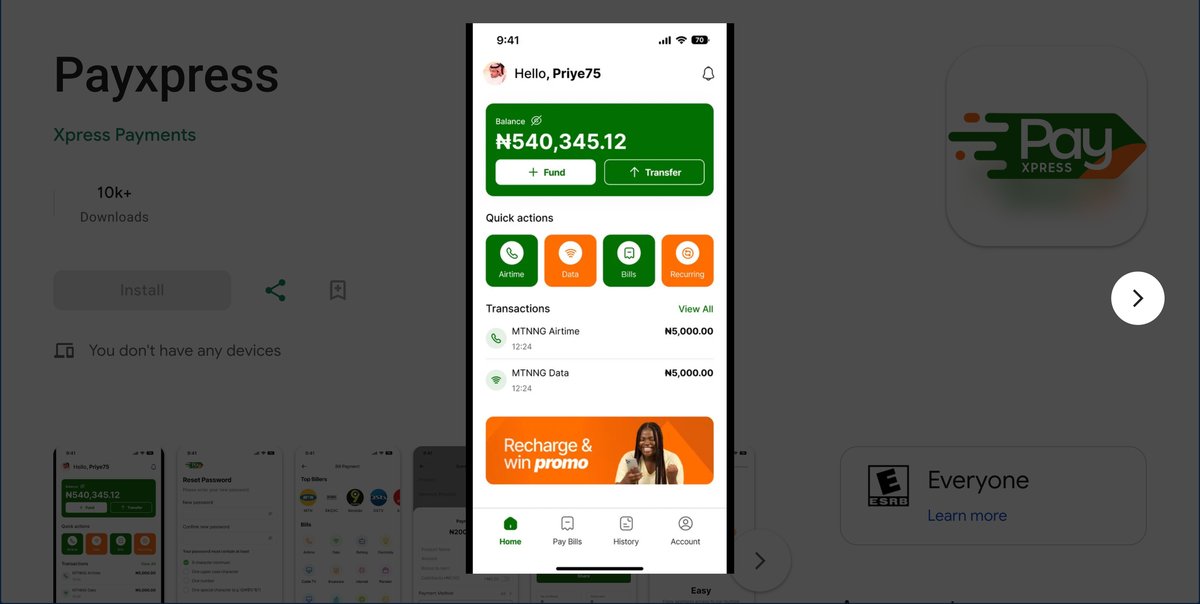
Payxpress, a consumer bills-payment app covering airtime, data, cable TV and utility bills, with recurring payment scheduling, a wallet balance and a transaction history view.
How it got built.
Scoped the initial category set (airtime, data, cable, utilities) around what consumers already pay monthly
Built provider integrations for each payment category
Shipped recurring payment scheduling and the wallet/transaction-history view
Reached 10,000+ Google Play downloads
How this reaches customers.
Acquisition around the highest-frequency use cases first, airtime, data, electricity, television and utilities, then move customers from a first transaction to a saved bill to a repeat payment to multiple bill categories. The strongest growth mechanism for a product like this is payment frequency, not installs alone, an install that never becomes a repeat payment hasn't actually solved the customer's problem.
North star metric.
Supporting metrics
- Recommended North Star going forward: monthly active successful bill payers, not downloads
- Successful transaction rate and repeat-payment rate
- Monthly transactions per user
- Time to first payment confirmation
Guardrails
- Failed transaction rate
- Support tickets per 1,000 transactions
The verified bottom line.
10,000+ downloads, one app for the bills people pay every month instead of switching between several.
What I'd do differently.
Downloads prove people are willing to try a consolidated bills app, they don't prove the app earned a place in someone's monthly routine. The next stage of this product is proving repeat, monthly usage, not just first-install adoption, which is why monthly active successful payers is the metric I'd push the team to rally around next, not download count.
More proof, more products.
See every product shipped and business built.