Addy Logistics
"Delivery you can depend on."
Unreliable last-mile delivery in Nigeria, customers and businesses had no dependable way to get a package from A to B without unpredictable delays.
How to read this case study: what I owned, what shipped and the verified outcome (My Role, What Shipped and Impact below) are factual. The surrounding strategy, vision, alternatives and metrics framework are interview-ready framing built on those facts, how I'd talk through the product thinking, not a claim that every metric or GTM motion was formally run at the time.
Challenges & baseline.
Challenges
Nigeria's logistics environment continues to face real infrastructure and operational challenges, road quality, cost and reliability among them. For customers, that meant unreliable last-mile delivery; for riders, it meant unpredictable job flow, the marketplace had to solve both sides at once, not just one.
Baseline
Last-mile delivery reliability before this product: fragmented, dependent on informal arrangements rather than a managed marketplace.
What the customer actually needed.
Insight
Last-mile logistics isn't primarily a software problem, it's a density problem. Without enough orders, riders and geographic concentration in a given area, the customer experience deteriorates no matter how good the app is, which is why coverage was built stage by stage rather than announced nationally on day one.
Job to be done
When I need something delivered, match me to a rider reliably and let me track the job, so I don't have to worry about whether it will actually arrive.
Vision, mission & the bets we made.
Reliable delivery anywhere customers need it.
Connect delivery demand with dependable last-mile capacity.
Match delivery demand to available riders reliably enough that customers trust the service; give riders predictable job flow rather than idle time; keep the marketplace healthy on both sides, not just optimised for one.
Ship the rider-facing job acceptance and delivery flow; ship the customer-facing delivery request and tracking experience; expand geographic coverage stage by stage.
Strategic bets
- Build density before geography, city then zone then merchant concentration then rider density then adjacent zones, rather than launching thin and nationwide
- Treat both sides of the marketplace, riders and customers, as equally important to product health, not just the customer-facing experience
- Expand stage by stage so each new area actually has enough supply and demand to work
Alternatives considered
The faster path to a national footprint was to launch broadly and thin, sign up riders and accept orders everywhere at once. That was rejected because thin coverage produces exactly the unreliable experience the product was meant to fix, low match rates, long wait times, customer churn. The direction taken instead built density stage by stage, city to zone to merchant concentration to rider density, before expanding to adjacent zones.
What I owned.
Product lead on Addy Logistics' rider/customer delivery experience.
What shipped.
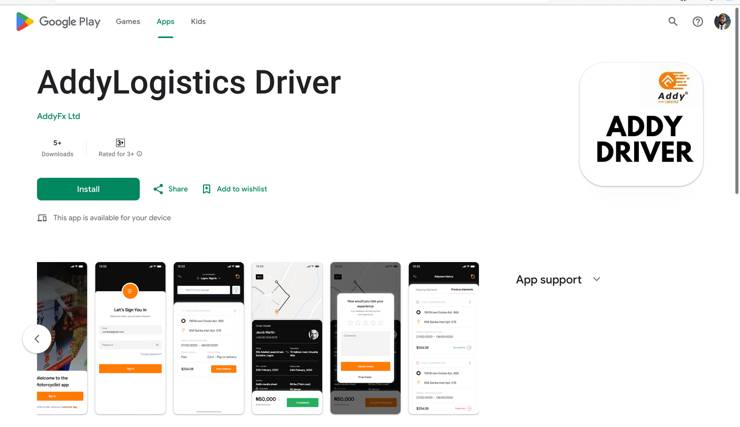
A last-mile delivery product for riders and customers, shipped to Google Play, with delivery coverage across 36 stages in Nigeria.
How it got built.
Shipped the core rider job-acceptance and delivery flow
Shipped the customer-facing delivery request and tracking experience
Expanded coverage stage by stage, reaching 36 stages in Nigeria
Published the app to Google Play
How this reaches customers.
Density-first expansion rather than a national launch: establish enough order volume and rider supply in one city or zone to make the marketplace actually work, then expand to adjacent zones once that density is proven, rather than optimising for stage count before the underlying supply-demand balance is healthy.
North star metric.
Supporting metrics
- Recommended North Star going forward: successfully completed deliveries, not stage count alone
- On-time delivery rate and delivery success rate
- Time-to-match between a request and an available rider
- Rider utilisation and repeat customer rate
Guardrails
- Cancellation rate
- Delivery cost and contribution margin per order
The verified bottom line.
Delivery coverage across 36 stages in Nigeria.
What I'd do differently.
Reach numbers like stage count are proof of expansion, not proof the marketplace is healthy where it's live. The stronger interview discussion isn't "36 stages", it's how density was built deliberately, city by city, before expanding, since thin coverage produces exactly the unreliable delivery experience the product exists to fix.
More proof, more products.
See every product shipped and business built.